

ISAF-ICE-ISIF-PFM 2025 will offer tutorial courses on Sunday, July 13, 2025.  Tutorials can be added to your registration. 

Tutorials are conducted by leading experts, researchers, or practitioners in the field. Attendees will benefit from direct access to their insights, experience, and advice. Tutorials are designed to provide focused, in-depth exploration of specific topics or emerging technologies. This structured format allows attendees to gain a deeper understanding that often goes beyond regular conference sessions.
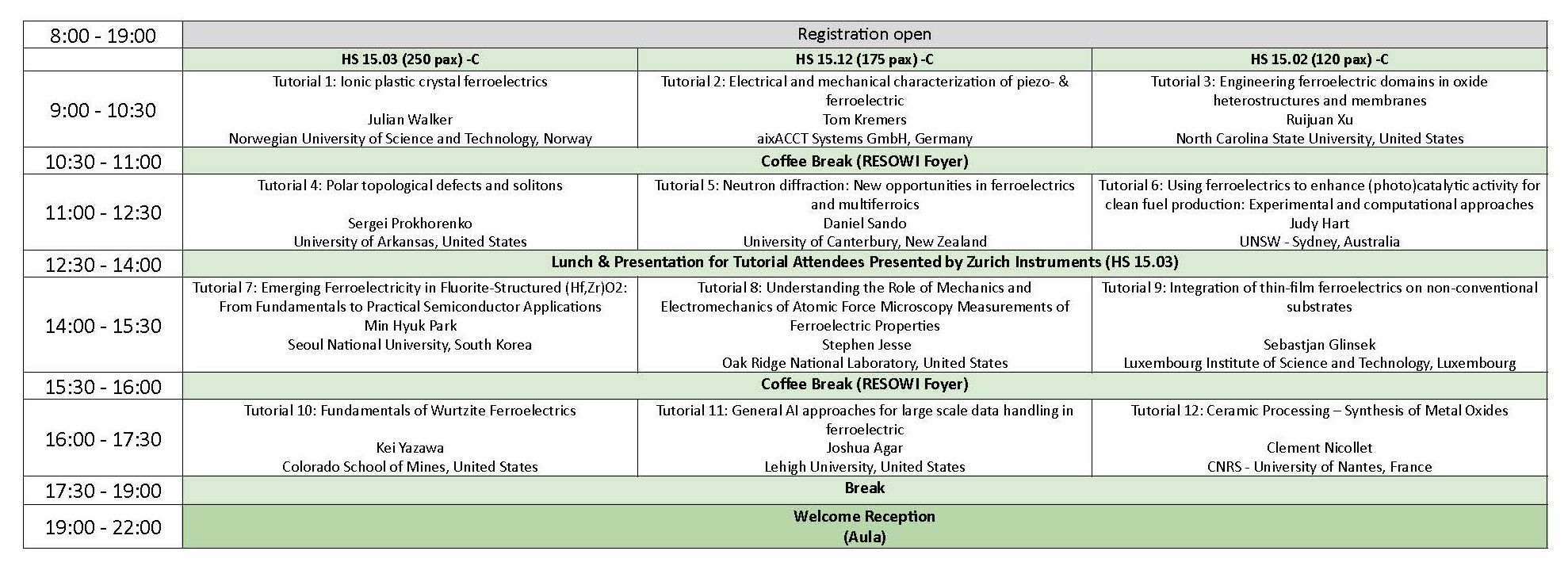
  • Future clean energy systems require efficient means of storing and transporting energy obtained from intermittent renewable sources, such as solar and wind. One way of achieving this is through electrochemical conversion of clean electricity to chemical energy stored in fuels such as hydrogen produced through water splitting [1]. Such electrochemical processes can be driven either directly by sunlight (referred to as photo-electrocatalysis) or indirectly (i.e. by producing electricity from solar, wind or other clean energy sources, which is then fed into the electrochemical cell).

  • Piezoelectric materials are integral to numerous advanced technologies including sensors and actuators due to their unique electromechanical coupling properties. Understanding and characterizing these materials require precise measurement techniques that reliably determine key parameters, such as piezoelectric coefficients, dielectric constants, and polarization behavior. This tutorial offers an in-depth exploration of the theoretical principles underpinning piezoelectricity and the advanced measurement methodologies used to evaluate these properties.

  • Ferroelectric materials exhibit electrically switchable polarization, with their nano- and mesoscale polarization arrangements giving rise to distinct ferroelectric domains. The functional properties of ferroelectrics, including their dielectric, piezoelectric, and ferroelectric responses, are intrinsically coupled to domain configurations. By strategically designing and controlling domain structures, these properties can be significantly enhanced. In this tutorial, I will focus on low-dimensional ferroelectrics, from epitaxial heterostructures to freestanding membranes, to introduce key strategies for domain engineering. Specifically, I will discuss how orientation control, electrostatic engineering, strain engineering, and size effects can be leveraged to tailor ferroelectric domain structures and induce emerging and competing ferroic orders in complex oxide heterostructures and membranes.

  • The ferroelectricity discovered in (Hf,Zr)O2 has garnered increasing interest from both academia and industry since its first report in 2011.[1] Even from the first report, the ferroelectricity could be demonstrated in sub-10-nm thickness, which is now confirmed within sub-1-nm thickness.[2,3] The origin of the unexpected ferroelectricity has been intensively studied and the formation of the metastable orthorhombic (space group: Pca21) or rhombohedral (space group: R3m or R3) phases is believed as the crystallographic origin. Owing to the robust ferroelectricity in sub-5-nm thickness regime which is beneficial to achieve low-power semiconductor devices as well as an endurable cycle number even beyond 1012 cycles of ferroelectric (Hf,Zr)O2, ferroelectric random-access memory is more promising for practical applications than ever.[4-6]

  • Wurtzite (Al,Sc)N bas been utilized as microwave resonator and filter devices in telecommunications due to its large electromechanical coupling. The recent discovery of ferroelectricity in (Al,Sc)N films provides opportunities for new material discoveries and device applications such as tunable filters and non-volatile memories. In this tutorial, I will present unique features of the wurtzite ferroelectric materials. Those include: (1) crystal phases in AlN based materials, (2) on Landau-Devonshire model and global strain effects on ferroelectric responses, (3) local bonding effects on ferroelectric switching pathway, and (4) anomalously abrupt kinetics in ferroelectric switching dynamics, and (5) leakage current mechanisms. Those fundamental understandings on wurtzite ferroelectric materials provide insights on further material design and improvement on material properties and device performance.

  • Perovskite ferroelectric thin films have been extensively studied over the past several decades and have been successfully integrated into various devices, including inkjet printheads, inertial sensors, speakers, and microphones.

    The breakthrough in their development was achieved with films grown directly on platinized silicon (polycrystalline films) or oxide single-crystal substrates (epitaxial films), which can withstand the high annealing or deposition temperatures (typically above 650 °C) required for their formation.

  • Neutron diffraction has become an essential technique for investigating the atomic and magnetic structure of ferroelectrics and multiferroics, offering distinct advantages over X-ray and electron-based methods. Since neutrons interact weakly with matter, they penetrate deeply into bulk materials, enabling non-destructive structural analysis as well as in-situ and in-operando studies. Additionally, their sensitivity to light elements such as oxygen can offer insight into lattice distortions and bonding environments. Crucially, neutrons directly interact with magnetic moments, making them well suited to studying magnetic order and magnetoelectric coupling.

  • Synthesis of metal oxides is typically the first step of any materials science research in a field or application involving oxides materials. However, the synthesis is rarely the prime focus in materials science, which usually describe properties and characterizations of said materials. Consequently, synthesis protocols are often given too little attention in the literature and hence poorly described. For scientists starting in the field, it becomes confusing to make the right choice of synthesis route and conditions to successfully prepare what will be the base of their research, which is a pure, single phase, complex oxide powder. 

  • In recent years, ferroelectric (polar) topological structures have become a rapidly growing area of research. A steady stream of experimental and theoretical studies reporting novel swirling patterns of polarization continues to expand the field, raising new questions about the underlying physical phenomena and functional properties that remain to be fully understood.

  • The atomic force microscope has emerged as a leading characterization platform for imaging and assessing the functional properties of ferroelectric materials at the nanoscale. Its usefulness derives from the combined ability to apply bias locally (10’s nm) via a conductive scanning probe and sense displacements of the surface (10’s of pm) to yield maps of ferroelectric domains and insights into the local switching behavior of ferroelectrics. However, one must exercise care when setting up an experiment and interpreting results since a range of phenomena, including electrostatic interactions between the scanning probe and the surface, can give responses that can appear as piezoelectric/ferroelectric behaviors. Properly navigating the landscape of nanoscale electromechanical phenomena demands cutting-edge expertise – both in the experimental part and high-level data analytics. This tutorial will start with an overview of how advanced Piezoresponse Force Microscopy (PFM) and related spectroscopic approaches developed over the last two decades have impacted the study of nanoferroics. This perspective will set the stage for then focusing on building a deeper understanding of the mechanics and electromechanics at play when DC and AC bias is applied to a scanning probe positioned at or near the sample surface and discussing strategies for mitigating spurious effects. The intent of this tutorial is to provide guidance for performing PFM and to raise awareness about what to look for when assessing the validity of results either while performing measurements or when examining the open literature.  

  • While molecular ferroelectrics are embedded in the history of ferroelectricity, with its discovery in Rochelle Salt (sodium potassium tartrate) crystals in 1920, they have not seen anywhere near the development of metal oxide ferroelectrics. In the last decade and a half however, significant discoveries and developments have occur in a new class of molecular materials known as ionic plastic crystals, and there is growing interest in this new class of ferroelectric to see if they can bring about new applications and niece functionalities.